
How N-Fab’s Welded Hoop Design Actually Protects Your Truck’s Rocker Panels from Rock Damage
Your truck’s rocker panels sit directly in the line of fire when you’re navigating rocky trails or uneven terrain. A single sharp rock kicked up at highway speed can puncture sheet metal, and trail obstacles scraping along the underside can fold that thin steel like foil.
We designed our hoop-style nerf bars specifically to address that vulnerability. Unlike bolt-on flat steps that leave gaps where debris can strike exposed metal, our welded hoop construction creates a continuous shield between the trail and your body panels, redirecting impact forces through thick-wall tubing instead of letting them reach the rocker.

Why a Welded Hoop Distributes Impact Forces Better Than a Flat Step
A traditional flat nerf bar bolts to two or three points along the frame and spans the distance in between with minimal intermediate support. When a rock strikes that open span, the entire impact force concentrates at the nearest mounting bracket — and if the bracket holds, the bar itself flexes, allowing the rock to continue upward into the rocker panel.
Our hoop design changes the geometry entirely. Each vertical hoop member ties directly into both the frame rail and a reinforced mounting plate, creating a triangulated load path. When impact occurs anywhere along the hoop, that force spreads across multiple welds and braces instead of loading a single fastener. The structure deflects the rock away rather than flexing inward, and the continuous tubing leaves no gap for debris to slip through and reach the body.
The difference becomes obvious the first time a trail obstacle catches the side of your truck. A flat bar might survive the hit but still allow the rock to scrape paint or dent metal above it. The hoop takes the entire blow on its outer curve and keeps the rocker untouched.
Material Thickness and Weld Quality: What Actually Matters in a Hoop Rail
Marketing specs often highlight tubing diameter, but wall thickness determines whether a hoop will hold its shape under real trail abuse. We use 1.75-inch diameter tubing with a 0.120-inch wall — thick enough that a direct strike from a softball-sized rock won’t collapse the tube or crack the weld seam.
Every hoop-to-mounting-plate junction is TIG-welded rather than MIG-tacked. TIG welding produces a narrower, deeper penetration bead that fuses the tubing to the plate without creating the kind of cold-lap weak points that appear in rushed production welds. You can verify weld quality visually: a clean, consistent bead with no gaps or undercut runs the full perimeter of each joint.
Powder coating follows welding, not the other way around. Some manufacturers coat components separately and then assemble them, which leaves the weld itself unprotected and prone to corrosion where moisture collects in the joint. Our hoops are welded first, then the entire assembly goes through a seven-stage wash and cure cycle so the coating bonds to both the tubing and the weld bead as a single corrosion barrier. The National Institute of Standards and Technology maintains surface-adhesion testing protocols that confirm powder-coat bond strength, and our process exceeds the minimum peel-resistance threshold for automotive exterior use.
How Hoop Position Affects Rocker Coverage Without Blocking Ground Clearance
The hoop’s vertical standoff from the body determines how much protection you gain versus how much clearance you sacrifice. Mount the hoop too close to the rocker and it restricts articulation when the suspension compresses over rocks; mount it too far out and debris can still reach the panel through the gap.
We position each hoop 2.5 inches outboard of the rocker’s lower edge. That distance is wide enough to intercept rocks before they contact sheet metal but narrow enough that the hoop itself doesn’t extend below the frame rail and reduce your truck’s breakover angle. On trails with deep ruts, the outside edge of the hoop might scrape, but the frame and rocker remain clear.
Vertical placement matters just as much. Our hooped nerf bars sit low enough that the top edge of each hoop aligns with the rocker’s bottom seam, creating an overlap that prevents upward-traveling debris from finding a path between the bar and the body. If you’ve experienced issues with mounting hardware loosening over time, the same principles that prevent debris intrusion also reduce the kind of high-frequency vibration that backs out bolts — though persistent rattling from loose brackets usually traces back to undertorqued fasteners or missing threadlocker rather than a design flaw.

Comparing Hoop Protection to Rock Sliders and Full-Length Rails
Rock sliders bolt directly to the frame with no step function and typically run the full length of the cab. They offer maximum protection because the entire lower body sits behind a continuous steel beam, but they add 60-80 pounds per side and eliminate any usable step surface.
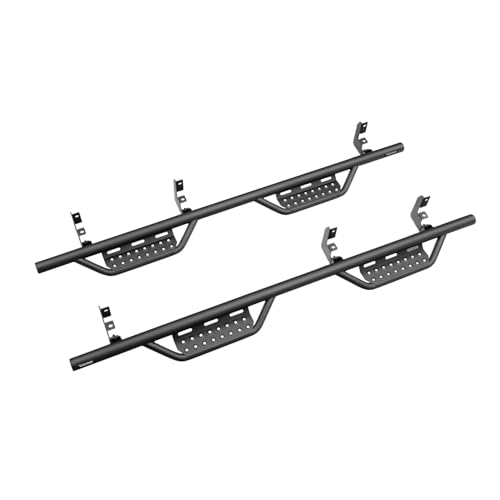
Our hoop bars split the difference. Each hoop section provides a 4-inch-wide step pad while the hoop itself extends below and around that pad to shield the rocker. You gain functional access to the cab without sacrificing the impact deflection that makes a slider effective. The trade-off is coverage area: a hoop bar protects the sections directly behind each hoop but leaves short gaps between them, whereas a slider is unbroken from wheel well to wheel well.
For trucks that see mixed use — daily driving plus occasional trail runs — the hoop design makes more sense. You’re not dragging the rocker across ledges the way a dedicated rock crawler does, so continuous coverage isn’t necessary. What you need is protection from the random strike: a kicked-up rock on the highway, a tree stump hidden in tall grass, a deep rut that forces one wheel up while the opposite side scrapes. The hoop intercepts those hits without the weight penalty or the $800-plus cost of a full slider kit.
If your truck splits time between pavement and technical off-road sections where undercarriage damage is common, our rock rail systems offer heavier-duty construction with integrated skid plating that extends protection forward to the cab mounts and rearward past the rear door. That additional coverage makes sense when trail conditions regularly put the entire length of the rocker at risk, but the added material means you’re carrying an extra 40 pounds and dealing with a more involved installation that requires drilling frame holes rather than using factory mounting points.
Installation Details That Affect Long-Term Protection Performance
Factory frame holes work for light-duty applications, but hoop bars carrying impact loads need through-bolted connections that engage both the inner and outer frame walls. Our kits include 1/2-inch Grade 8 hardware with serrated flange nuts that lock against the frame without requiring separate washers.
Mounting-plate orientation matters. Each plate has a specific front-to-back alignment that positions the hoop at the correct angle relative to the rocker. Installing a plate backward — which is possible because the bolt pattern is symmetrical — tilts the hoop either inward or outward by several degrees, which changes how impact forces distribute and can leave a gap at the top edge where debris slips through.
Torque specs are listed in the included instructions, but they assume clean, dry threads. If you’re installing in wet or muddy conditions, or if the frame holes have surface rust, apply a thin layer of anti-seize to the bolt shanks before tightening. That prevents false torque readings caused by friction on dirty threads and ensures the clamping force actually seats the plate against the frame rather than just turning the bolt.
After the first 500 miles, check every fastener. Frame flex during normal driving can loosen hardware that was properly torqued at installation, especially on trucks with softer suspension setings that allow more body roll. Retightening once after the initial break-in period eliminates 90 percent of the rattle complaints we see, and after that the connection stays solid indefinitely. Drivers who maintain other DNA Motoring upgrades often follow the same torque-check interval across their entire build to catch any loosening hardware before it becomes a problem.
Choosing Hoop Protection That Matches Your Truck’s Real-World Use
Hoop-style nerf bars make sense when you need functional step access and rocker protection without the weight and cost of full rock sliders. The welded construction and continuous coverage eliminate the weak points that let debris reach your body panels, and the triangulated load path ensures the structure holds up under trail impacts that would fold a bolt-on flat bar.
If your truck sees mostly pavement with occasional off-road detours, the hoop design delivers the protection you need without sacrificing ground clearance or adding unnecessary weight. For more aggressive trail use where the entire undercarriage takes repeated hits, stepping up to a dedicated slider system makes sense — but for the majority of truck owners, our hoop bars hit the right balance between access, protection, and cost.
Common Questions About Hoop-Style Rock Protection
Most of our hoop bars use existing frame holes or factory-drilled mounting points, which means no drilling is required for installation. A few heavy-duty models designed for severe off-road use do require new holes to accommodate through-bolted reinforcement plates, but those kits include detailed drilling templates and the necessary step bits to ensure accurate placement.
If your truck already has aftermarket sliders or nerf bars installed, you may need to remove those first and verify that the original mounting holes are still clean and threaded. Stripped or damaged threads will need a Helicoil insert or a larger-diameter fastener before the hoop bar can be safely installed.
A leveling kit or mild lift actually improves the functional clearance between the hoop and the ground because it raises the frame without changing the hoop’s position relative to the rocker. You gain an extra inch or two of space beneath the bar, which reduces the chance of scraping on steep approaches.
Larger lifts — 4 inches and up — can create a different issue. The increased ride height moves the rocker higher as well, and if you mount the hoop at the stock offset, the gap between the bar and the body widens enough that rocks can slip through. In those cases, you may need extended drop brackets that lower the hoop mounting point to restore the original 2.5-inch standoff distance and maintain full coverage.
Every hoop bar model is designed for a specific cab style and wheelbase combination. Our product pages list the exact year, make, model, and cab type each bar fits, along with notes about crew cab versus extended cab and short bed versus long bed configurations.
If you’re unsure about your truck’s specifications, check the door jamb sticker or the original window sticker for the cab code and bed length. Double-cab, quad-cab, and crew-cab designations vary by manufacturer, so matching the wheelbase measurement in inches is the most reliable way to confirm compatibility.
Aftermarket modifications like bed swaps or frame extensions will usually prevent a direct fit. In those cases, universal-mount rock sliders that attach with custom fabrication are a better option than trying to adapt a vehicle-specific hoop bar to a non-standard configuration.
A pressure washer with a rotating nozzle clears packed mud from inside the hoop tubing and around the mounting plates faster than a garden hose. Spray from the bottom up so debris falls out through the drain holes rather than getting forced deeper into the assembly.
After washing, check the powder coating for chips or scrapes. Small damage spots can be touched up with high-temp spray paint to prevent rust from starting in the bare metal. Larger areas where the coating has peeled away from impact should be sanded smooth, treated with a rust converter if any corrosion is visible, and then recoated with a two-part epoxy primer before applying color-matched paint.
Avoid using a wire brush or abrasive pads on the powder coat itself. Those tools scratch the finish and create microscopic channels where moisture can penetrate. A soft-bristle brush and soapy water are sufficient for routine cleaning, and stubborn mud breaks loose after soaking with a degreaser for a few minutes.
Hoop bars replace running boards rather than working alongside them. The hoop itself occupies the same mounting points and vertical space that a traditional running board would use, so you’ll need to remove any existing boards before installation.
Side-mounted accessories like bed-rail tool boxes or tie-down anchors usually don’t conflict with hoop bars because they attach to the bed rail rather than the frame. Check the clearance between the hoop’s rearmost section and the front edge of the accessory to make sure there’s at least half an inch of space — anything tighter than that can cause contact noise when the bed flexes over rough terrain.
Our hoop bars are rated for 500 pounds of static load per step pad, which is more than sufficient for any adult stepping into the cab. Dynamic loading — such as jumping onto the step or placing all your weight on one foot while twisting to reach into the bed — generates higher forces, but the welded hoop structure distributes those loads across multiple mounting points and prevents the kind of deflection that would bend a flat bar.
If you regularly carry heavy gear and need to stand on the step while loading or unloading, position your weight over the hoop section rather than in the center of the step pad. That keeps the load path direct from the pad through the hoop to the frame mount, rather than forcing the pad to cantilever out from its nearest support point.